

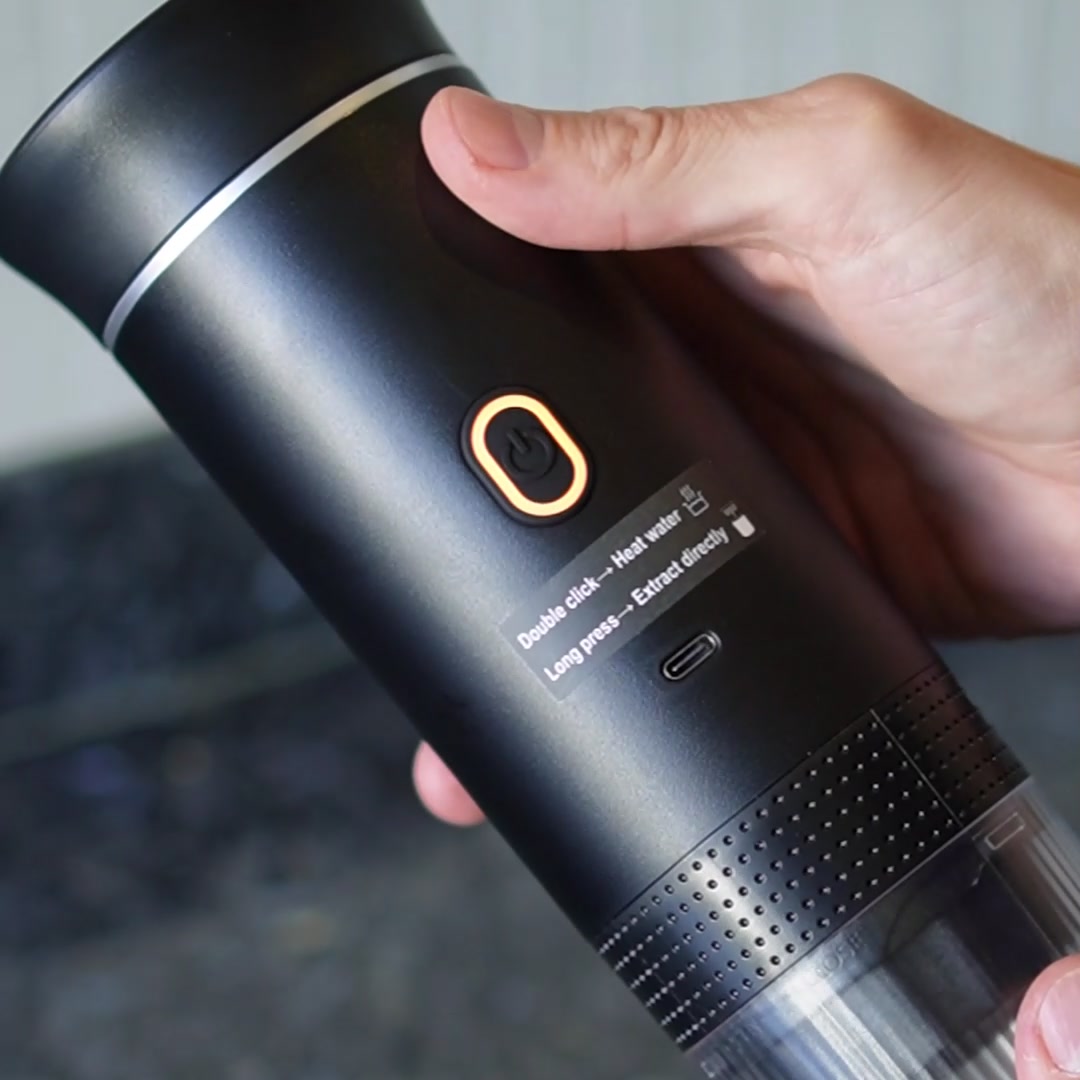
A portable espresso machine with USB-C is only really handy if you know how to charge it. We have a separate article about brewing without a power outlet in nature. This one is about charging: with a power bank, via the USB in your car or from your laptop. After that you brew without a cable once the battery is full.
How many shots you get from a power bank with a certain number of mAh varies. Further down you'll read what it depends on.

First, the distinction: charging vs brewing
- Charging: USB-C cable connected to a source (adapter, power bank, car, laptop).
- Brewing: machine unplugged, running on its internal battery, whenever you want espresso.
That separation is the whole point of a rechargeable portable espresso machine. You plan charging the way you plan for your phone. You plan brewing for the moment it tastes best: kitchen, parking lot, campervan countertop.
What you need (honest and generic)
Use a good USB-C charger in the ≥10W class, or higher if your charger safely supports it. There's no exotic proprietary port. We don't promise an exact charging time or number of shots, because that depends on temperature, how full the battery already was and how you use it.
Rule of thumb:
Charge before you leave and bring a cable you already trust. Don't use dodgy no-name chargers that get hot, or cables that kink.
Which power bank brand or model you pick is up to you. Just choose a power supply that meets the charging requirements stated on the device.

Option A: power bank
A power bank is handy if you travel for days without a fixed power outlet but still want to top up in between.
It does mean:
- Choose a power bank with a USB-C output that delivers stable power
- Charge the espresso machine while stationary, not "on the move in a jostling bag"
- Keep the power bank and machine dry
It doesn't mean:
- Claiming exact mAh requirements or "X shots per bank" without measuring
- Forcing brewing and charging at the same time as if it were required (brew when the battery is ready)
Think of a power bank as a backup for topping up. It doesn't mean endless espresso.
Option B: car USB / 12V USB adapter
In the car, you often have USB-A or USB-C in the dashboard, or a 12V plug with USB ports.
It does mean:
- Charge during a break or while parked with accessories on
- Check whether the port delivers enough power (cheap splitters sometimes deliver too little)
- Use a short, sturdy cable
It doesn't mean:
- Letting the machine dangle on the passenger seat with the cable pulled tight
- Assuming every USB port in every car is equally powerful
Car USB is ideal for topping up between stops. It's not your only plan if the port turns out to be weak.
Option C: laptop or monitor USB-C
At the office or on the train (stationary, tidy), you can sometimes charge from a laptop's USB-C port.
It does mean:
- Laptop plugged into mains power if you want faster or more stable charging
- Nomad next to the keyboard, not on the keys
It doesn't mean:
- Expecting every USB-C port on every laptop to do PD charging equally fast
- Brewing coffee in the middle of an open workspace without agreeing on mess or smell
Laptop charging is a bonus, not a primary strategy for a week of camping.
How the Nomad fits in
The Rolling Roast Nomad charges via USB-C and then brews on battery. Compact enough (~24.5 cm, ~650 g) to sit next to a power bank in a daypack or kitchen drawer. You'll find the current price on the product page. Colors: Green, Black, Silver. Pressure: 20 bar. Water up to 60 ml. Ground coffee up to 8 g.
The Nomad works with capsules in Nespresso® format and Dolce Gusto® format (including capsules from brands such as Nespresso, Dolce Gusto or Starbucks in those formats), plus ground coffee.
That makes charging relevant for anyone who already has capsules: charging is universal USB-C, brewing remains your ritual.
Controls after charging
Battery charged? Then:
- Insert a capsule or ground coffee
- Add water
- Press twice (2×) to heat up
- Hold 2 seconds to brew
No one-touch. But clear: heat up first, then brew.
A charging rhythm that works
| Moment | What you do |
|---|---|
| The evening before you leave | Nomad on a USB-C adapter (≥10W class) |
| On the road | Only top up via car USB or power bank if needed |
| On location | Brew cable-free; rinse; back in your bag/drawer |
| Back home | Fully charged again for the next round |
This rhythm prevents disappointment better than "I'll find a power outlet when the craving hits".
What this article isn't
This isn't the guide about outdoor espresso without a power outlet; that one is about use in nature. This one is about where you charge USB-C espresso and how you plan it with a power bank, car or laptop. So you won't find tables of shots per battery or wattages here: we have no measured data for them.
What it comes down to
With USB-C, a portable espresso machine fits in with the chargers you already have. Use a decent charger, charge before you leave and then brew without a cable. That's what the Nomad is made for, in Silver, Green or Black: USB-C and battery-powered heat-brew, with the current price on the product page.

Ready to charge and brew yourself? Buy the Nomad: Buy the Nomad
Nespresso® and Dolce Gusto® are trademarks of Société des Produits Nestlé S.A. Starbucks® is a trademark of Starbucks Corporation. Rolling Roast is not affiliated with, endorsed by or sponsored by Nestlé or Starbucks.
Deel:
Coffee in the campervan without a 12V installation
Dolce Gusto®-compatible capsule format espresso on the go: how it works